

The SXSW Corporate Takeover Tracker: Block by Block, Brand by Brand
We mapped every corporate activation zone in downtown Austin during SXSW. It took three days and most of our will to live.
"SXSW 2025 had more corporate activation zones than public restrooms. Somewhere, a banjo player weeps into his kombucha."
Here is a true thing that happened in March 2024: I tried to walk from the Austin Convention Center to a taco truck on East 4th Street — a distance of roughly six blocks — and I passed through the sovereign marketing territory of Amazon, Meta, Porsche, Delta Airlines, and a sparkling water brand whose name I've already suppressed as a psychological defense mechanism. Each one had erected a temporary structure. Each one had a line. Each one required a badge scan, a waiver, or both. The taco truck had closed. It had been replaced by a "Culinary Innovation Pop-Up" sponsored by a meal-kit delivery service.
I did not get a taco. I got a "deconstructed street food experience" served in a compostable bowl by someone wearing a headset. It tasted like content.
The Map
We've been tracking SXSW's corporate footprint since 2018, and the growth pattern is less "gradual expansion" and more "invasive species with a marketing budget." Here's the trajectory:
2018: Corporate activations occupied roughly 8 city blocks, mostly clustered around the Convention Center and Rainey Street. The rest of downtown remained navigable. You could still find a bar that was just a bar — no wristband, no activation code, no branded photo booth. Just a Lone Star and a jukebox.
2021: Post-pandemic SXSW returned smaller but hungrier. The brands that showed up had something to prove, and what they proved was that they could turn a parking garage into a "Web3 Wellness Lounge" in under 72 hours. The footprint jumped to 14 blocks.
2024: We counted 23 distinct corporate activation zones spanning from Cesar Chavez to 8th Street, Congress to I-35. Nearly every available lot, warehouse shell, and former dive bar had been leased for a temporary branded experience. The highlights — or lowlights — included:
- A two-story Amazon structure on Trinity Street with its own security perimeter, DJ booth, and a "Creator Economy Summit" that required a separate RSVP inside an already-badged event. Inception, but for lanyard people.
- The Porsche "Electric Avenue" experience on Rainey Street, where you could test-drive an electric Taycan around a closed course for approximately 90 seconds, which is coincidentally how long it takes to forget that Rainey Street used to be a neighborhood where people lived in bungalows and didn't need valet parking.
- A wellness brand's "Mindfulness Dome" near Brush Square Park — an inflatable geodesic structure where attendees could meditate for five minutes while ambient music played and a screen displayed real-time biometric data from their Apple Watch. Achieving inner peace has never been so thoroughly surveilled.
The Displacement Math
Here's what corporate activations replaced, block by block: food trailers, street performers, unofficial showcases, and the general chaos that made SXSW feel like a festival instead of a trade show with a cover band. The unofficial stuff — the random warehouse show, the pop-up gallery in someone's garage, the band playing on a flatbed truck — that was the texture. That was the thing that made people fly to Austin instead of just watching the keynotes on YouTube.
But unofficial doesn't have a sponsor deck. Unofficial doesn't generate "impressions." Unofficial can't justify $400,000 in temporary construction costs for a photo-op wall that says "HELLO FUTURE" in neon.
The same pattern that turned South Congress into a condo brochure has come for SXSW's streets. The difference is that on South Congress, the displacement is permanent. At SXSW, it's seasonal — the brands pack up in late March, leaving behind a downtown full of zip-tie scars on light poles and the faint scent of branded hand sanitizer. Then they come back. They always come back. And every year, they bring one more block's worth of stuff.
SXSW 2024 had more corporate activation zones than public restrooms. Somewhere, a banjo player weeps into his kombucha.
You can see the restroom situation for yourself in the Porta-Potty Census. And if you've read this far and decided to simply flee the city during SXSW — the correct response — consult the Local Survival Guide. We have routes.
More from SXSW Ruin Counter
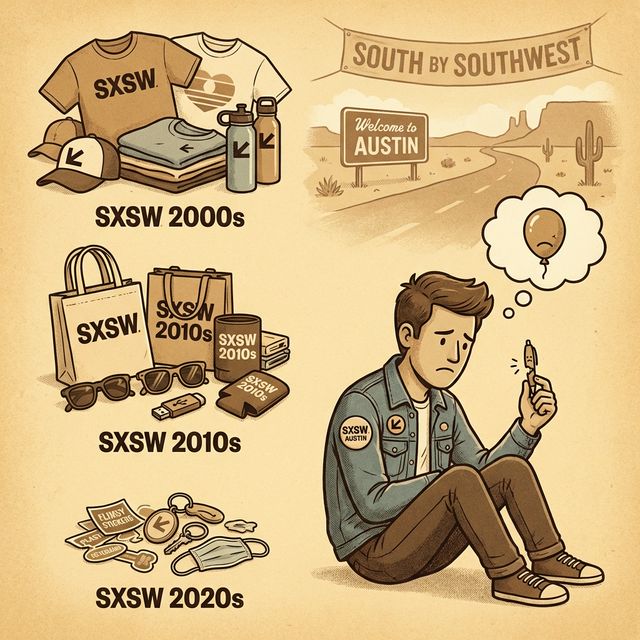
The SXSW Free Stuff Quality Index: A Decline Measured in Koozies
The free stuff used to be good. Then it was fine. Now it's a QR code printed on a napkin.
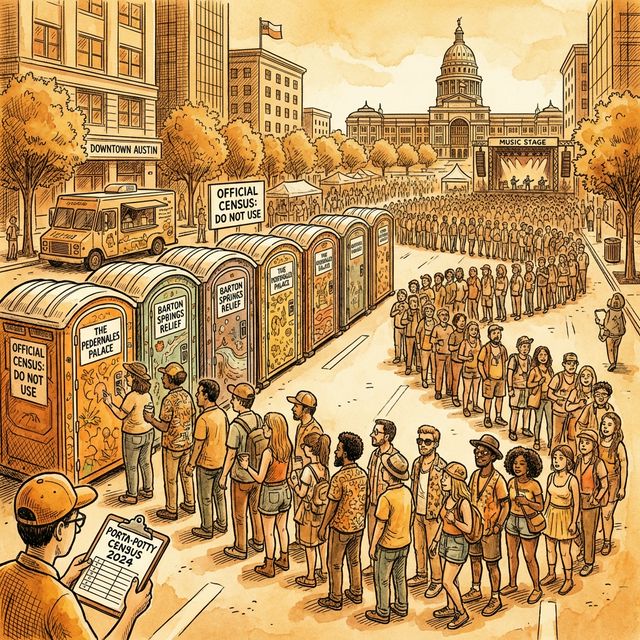
The SXSW Porta-Potty Census: What 1,200 Plastic Toilets Say About Late Capitalism
We counted the porta-potties so you don't have to. The findings are damning and poorly ventilated.
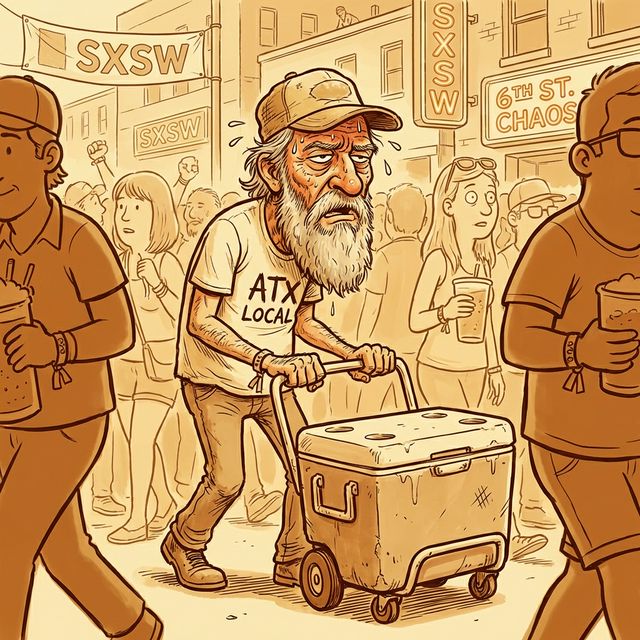
The SXSW Local Survival Guide: Or, How to Live in Your Own City for Two Weeks
A tactical guide for Austinites who want to survive SXSW by doing the only sane thing: avoiding it completely.
More on These Topics
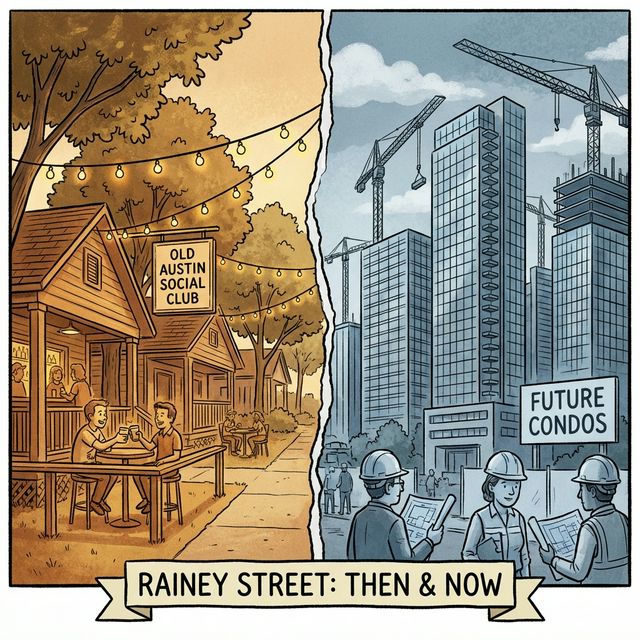
Rainey Street Remembers
Rainey Street used to be a quiet block of house-bars where you could drink a Lone Star on a porch. Now the porches are in the shadows of 40-story towers.
Parking Downtown: A $3 Meter, a $30 Garage, and the Death of Spontaneity
Parking used to be an afterthought. Now it's a second mortgage.
Liberty Lunch: A Ghost Story in Three Chords
They tore it down in 1999 and put up an office building. The bass notes are still in the soil.