
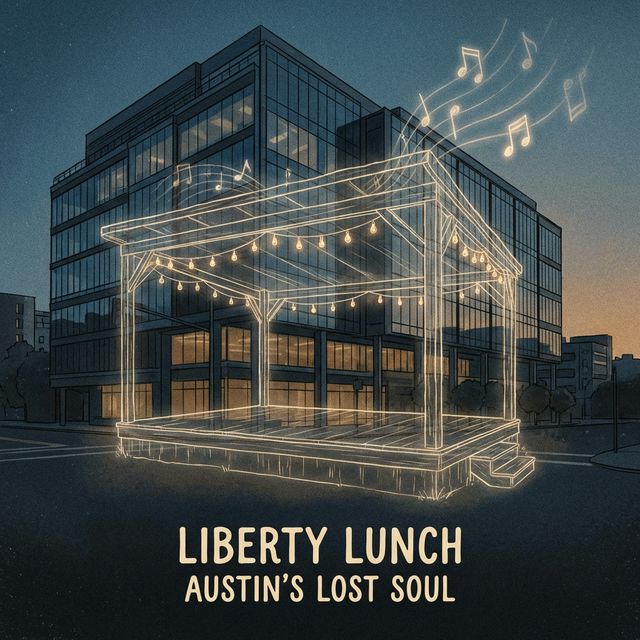
Liberty Lunch: A Ghost Story in Three Chords
They tore it down in 1999 and put up an office building. The bass notes are still in the soil.
"Liberty Lunch didn't have a brand. It had a corrugated metal roof and the best sound in Texas."
If you know, you know. And if you don't, that's the whole problem with this city now.
Liberty Lunch sat at the corner of West 2nd and Guadalupe, an open-air venue with a corrugated metal roof, a concrete floor that held twenty years of spilled beer like geological strata, and a sound system that could rearrange your internal organs from the back row. It opened in 1975. It closed in 1999. In between, it was the beating, distorted, unapologetically loud heart of Austin's music scene.
The Butthole Surfers played there. Nirvana played there before anyone outside of Seattle knew who they were. Iggy Pop played there. The Flatlanders. Lucinda Williams. Joe Ely. Alejandro Escovedo. On any given Tuesday, you could see a band that was about to blow up, or a band that had already blown up but still played like they were in somebody's garage, because that's what Liberty Lunch did to people. It made you play like it mattered.
Liberty Lunch didn't have a brand. It had a corrugated metal roof and the best sound in Texas.
Here's what you need to understand about Liberty Lunch:
- The capacity was roughly 1,000, but it felt smaller because the stage was low and the crowd was close and the whole place operated on the principle that music should be a contact sport.
- There was no VIP section. There was no bottle service. There was a bar that served Lone Star and Shiner and if you wanted something fancier than that, you could go somewhere else — and plenty of somewhere elses have since been built on every adjacent block.
- The outdoor area was just outside. Not a curated patio. Not a biergarten concept. Just Texas sky and cigarette smoke and the sound of the next band warming up through the walls.
They tore it down to build a City of Austin office complex. A municipal building. The kind of place where people schedule meetings about parking meters. If that isn't the most efficient metaphor for what happened to this city, we don't know what is.
Mark Murray, who booked the place for years, once described it as "the living room of Austin music." That tracks, except nobody's living room has ever made your chest vibrate at 110 decibels during a Timbuk 3 set.
The demolition in '99 was the first time a lot of us realized that Austin's music scene wasn't protected by anything — not by love, not by legacy, not by the fact that every politician in this city has used "Live Music Capital of the World" as a campaign slogan at least once. It was protected by nothing. And so nothing is what eventually showed up in its place.
You can still find people who'll tell you exactly where they were standing during a specific show at Liberty Lunch. Ask them. Buy them a beer. They'll give you that look — the one that's half smile, half funeral — and they'll tell you about the night the power went out and the band kept playing acoustic, and the whole crowd sang along, and for ten minutes nobody thought about rent or traffic or what Austin was becoming.
If you've ever wondered why people get misty-eyed about old Austin, Liberty Lunch is usually where the mist starts. This city has lost a lot of venues since, but this one broke the seal.
The office building is still there. We walk past it sometimes. We don't hear anything. That's the point.
More from Lost Venues & Dive Bars
The Armadillo World Headquarters: Where Austin Became Austin
Before it was a parking lot and then a high-rise, it was the room where rednecks and hippies decided to get along.
Las Manitas Avenue Cafe: The Counter Where Austin Used to Sit
They closed in 2008. Congress Avenue has never fully recovered. Neither have we.
Emo's on Sixth: Before the Move, Before the Mourn
The original Emo's wasn't a venue. It was a bruise you were proud of.
More on These Topics

The SXSW Corporate Takeover Tracker: Block by Block, Brand by Brand
We mapped every corporate activation zone in downtown Austin during SXSW. It took three days and most of our will to live.
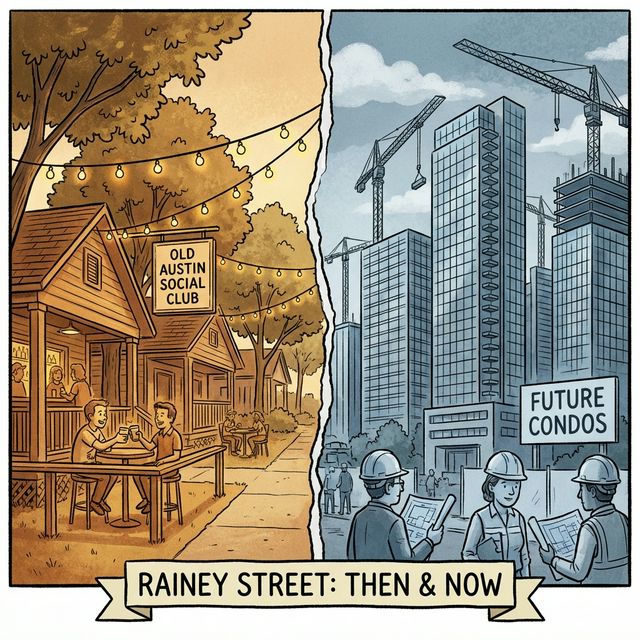
Rainey Street Remembers
Rainey Street used to be a quiet block of house-bars where you could drink a Lone Star on a porch. Now the porches are in the shadows of 40-story towers.
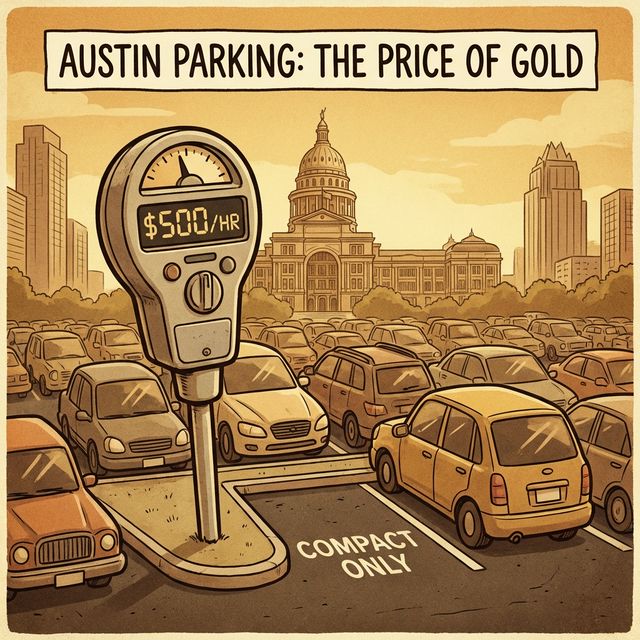
Parking Downtown: A $3 Meter, a $30 Garage, and the Death of Spontaneity
Parking used to be an afterthought. Now it's a second mortgage.